Tuesday, April 10, 2012

Skipper's Log 2006 part 5 - Barcelona to Sete


Skipper’s Log 2006 –Part 5  Barcelona to Sete
                                           
The intended stay of three nights in Andraitx turned out to be seven altogether. This was partly so I could rest my arm in a sling – (I had pulled a muscle in the upper arm), and also we liked the place so much. Rie made a big mistake while shopping. She bought what she thought were frozen fish fillets. When thawed out they turned out to be squid! We had a recipe for stuffed squid so all was not lost – but it was not our favourite dish.While in Andraitx I managed to install the “lazyjack” system I had bought in Palma, it should make it easier to drop the main sail.

Ruth & Søren

The day before we left, a Danish boat came in- “Sheer Magic” – from Lynetten harbour, near Copenhagen. She was a Vasa, about 45 ft long, and we quickly became friends with Søren and Ruth. Eventually on 31st August, we moved on to Soller, where we found the public pontoon almost empty – the main season was already over. We only intended staying one night, but Søren and Ruth arrived next day and moored next to us. We stayed an extra night – Soller is a difficult place to leave. Ruth and Rie went off swimming together while Søren and I visited the maritime museum – which did not impress us much.

On 2nd September, we decided to move on, but we were invited to lunch aboard “ Sheer Magic” before setting off. We departed, bound for Barcelona, in bright, hot sunshine and little wind. The sea was flat calm, and we saw some dolphins an hour later.

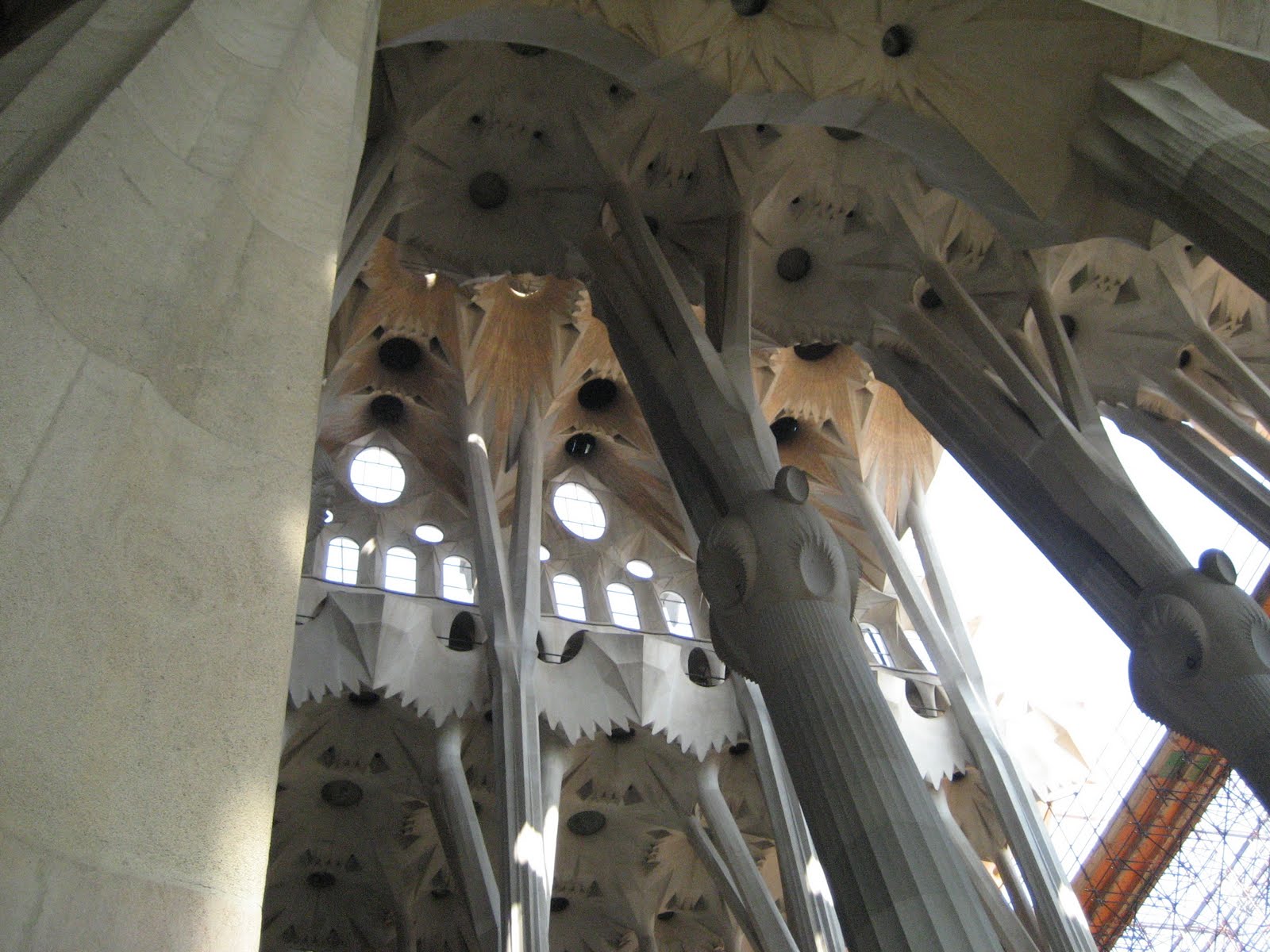
The night sail was uneventful, but in the first few hours of darkness, we had a bright moon to light our way and phosphorescence in our wake. We arrived in Barcelona around 10 in the morning and found a berth in Port Vell, right near the city. We stayed three nights in Barcelona, and the highlight of our stay here was our visit to the Sagreda Familia church which was designed by Gaudi and is still under construction over 100 years later!. It was a very special experience seeing and hearing the stone masons at work. It was, to say the least, a very special design. The pillars represented the trees of the forest, and the ceiling the forest canopy. Gaudi worked on the project for 40 years until he was run over by a tram. They hope to complete the roof in 2010.

Gaudi’s church

Interior

Unfortunately Rie’s purse was stolen outside the church, while I was up the older towers. She lost credit cards as well as cash and her health security cards.

Another day we visited Barcelona’s cathedral, which is near the roman walls. In the cloisters were 12 geese that represented the 12 apostles.


From there we walked over to Las Ramblas, this is a long , broad pedestrian way through the city. There were many stalls along the way, selling flowers and pets. Also there were street musicians and human sculptures – some of the best we have seen. There were also many pavement restaurants and very many people.

 On Las Ramblas


From Barcelona, we sailed to Blanes, a large harbour, where we found a berth alongside a Swiss boat. The weather was still sunny and flat calm, so we motored all the way. The next day, we continued to L’estartit which is another good sized harbour, and we moored bows to the mole.The harbours around here cater very much for dive boats. There was also a good beach and the town is a holiday resort. The next harbour we came to was Port Vendres – we were now in France – strange to have left Spain. We noticed that most tourists were now French, not foreigners.

Up goes the French courtesy ensign.

Gruissan was our next port of call. Here we moored alongside a quay for the night – another large harbour, run by the local Chamber of Commerce. When we came to Cap d’Agde, we decided to stay a week while we hired a car, and drove to Provence to visit Rie’s niece, Stine and the children in Montauroux. While there, we bought a cheap mountain bike – for use along the canals.

 Rie with Stine, Magnus and Matilde.

We felt Cap d’Agde was a good secure harbour to leave the boat. It was a very touristy place, with holiday apartments surrounding the multiple harbour – but security was good. We were the only non-French boat in the Centre Port!

On our drive back from Provence, we experienced a heavy thunderstorm, with torrential rain which brought motorway traffic to almost a standstill. We called in at the Intermarché in Agde on the way back and stocked up while we had the car. On the Saturday, I returned the hire car in Agde and cycled back to the harbour, mainly along cycle paths. We checked out of Cap d’Agde marina after lunch and sailed over to Sete, with just the genoa up. We had a moderately strong wind and uncomfortably big following waves. The forecast for the next week was for stronger winds, so we made a dash for it. We found a berth in Sete’s Vieux Port and made enquiries about dropping the mast. They said they could do it on the Tuesday (19th Sept). This was  fine as it gave us time to get the mast and supports ready, and as Poul was due to arrive on the Monday.

Skipper's Log 2006 part 4 - Mallorca & Menorca to Barcelona


                      Skipper’s Log 2006 – Part 4 - Mallorca&Menorca toBarcelona

                 
We left Restless 2 in Soller for four weeks, while we flew home to Denmark. On the 20th, Poul Henriksen flew out for a holiday, using Restless as a base. He sailed restless from the quay and anchored out in the bay. He had with him his daughter and granddaughter. After about 10 days they flew home, and his wife Linda flew out.

We returned to Restless on the 8th August, and Poul met us at the airport with a hire car. A good friend, Ragni Malmqvist, flew out with us. Just as the last bag was lifted aboard from the dinghy, it started to rain heavily and there followed a mighty thunderstorm for the next few hours. I stayed up until midnight with the motor running, in case we needed to clear out quickly. Several of the nearby boats dragged their anchors – almost the norm with charter boats – but our anchor held fast as Poul had found a patch of sand to dig the anchor into. After midnight, the wind died down, but we were left with an uncomfortable swell.

The next day, we took the tram to Soller town and met up with Poul and Linda. They had found accommodation in the town for the rest of their stay on Mallorca.

    
Dan with Linda, Poul and Ragni

The next day, we went for a long walk up to the lighthouse on the southern side of the bay. We could look down on Restless, bobbing at anchor.
 Restless at anchor in Soller
We had packed a lunch, which we eat , while looking out to sea.

Rie and Ragni


Soller bay

We moved to the Port Authority quay on in the afternoon, so we could fill up with water and top up our batteries. With the availability of shore power, we hoovered the boat throughout. The rubber dinghy, which had been afloat for just two weeks, had a good covering of barnacles and weed on the underside. This we scraped off and washed the remaining slime off with soapy water.

The next day, 11th August, Poul collected Rie early in the morning and they drove to Eroski, a good supermarket in Soller town to stock up. We said goodbye to Poul and Linda today, and left Soller just after midday. The wind was fine on the bow along the west coast. We looked in to Cala Colabra, where the tour boats go. This was an interesting place, but we didn’t stop, as our destination was Cala de Vincente further along the coast.


Cala Colabra

The coast along here is dominated by high vertical cliffs and there is a depth of around 60 metres right up to the rock face. When we came to Cala Vincente, there was a big swell rolling straight in. So I took the advice of a local sailor I had talked to in Soller, and looked into Cala Val de Borca, just a little further along, easily missed if not known about.

Cala Val de Boca.


Here we found shelter in what must be the wildest place we have anchored. There were steep cliffs up either side and we watched in amazement as we saw a wild goat climbing up the one side, foraging in the clumps of grass. We still rolled a little when the wind swung us sideways on to the waves. The night was dark, with no background lights, so we could see millions of stars.

The next day, 12th August, we continued round the NW point of Mallorca, and into the bay of Pollensa. There were no berths available in the harbour, so we anchored NE of the harbour. The wind blew up in the evening, but here we were protected from all directions. We stayed aboard this evening as a dinghy ride ashore would have been a wet bum affair.

The next day, we took the dinghy ashore and looked around the town a little and had lunch in a side street café.


 Then we caught a bus to the old town of Alcudia. Being Sunday, the regular shops were closed, but the Sunday market people were just packing up as we arrived. However, we had an interesting walk around the town and saw the two main portals. One had a causeway over a moat and the other still had the remains of a wooden portcullis.

portcullis

The ancient city walls were really thick, and in good condition where they had survived modern building. The modern town of Alcudia is outside the fortified walls though –that is where all the big shops are – we didn’t go there.
Alcudia walls

We caught the bus back to Pollensa, and found a Spar shop open, so topped up with supplies. The water in the bay was clear and clean, so Rie and Ragni enjoyed swimming around the boat.


We left Pollensa around 8.30 am on the 14th August and were soon sailing with a fresh SE breeze. What a relief to be sailing without the motor on. Our destination was Ciutadella, but when we were 12 nm off and sailing at a good 6 kn, we changed course for Fornells on the northern tip of Menorca. Ciutadella is not a good place to be, as in certain conditions they get a big surge into the harbour, a mini sunami. In June, about 40 boats were damaged here, as a result of a storm surge.

We arrived in Cala de Fornells at 8.30 pm and found the place covered with moorings. We found a place to anchorwell into the cala, and had a peaceful night in this unspoilt place. The cala is long and narrow, and well well protected from swell, except from the north.

The next day we had a late start and took a dinghy ride into the village and found a supermarket. It was also a chance to get rid of our rubbish.


The village has developed as an up market tourist resort – no high rise hotels here – but there were many holiday villas blended nicely with the older buildings.


 Porto de Fornells

 Ragni has a snack
To the south of our anchor place, there was a yacht club from where a large fleet of Lasers and Laser Pico sailing dinghies came. The youngsters seemed to have a great time in the breezy conditions.


Later in the day, I returned to fetch water in cans, it took a long time to fill 50 ltrs from a drinking fountain!. On the way back, I became completely soaked as the wind had picked up from the south and kicked up a nasty chop.

The next day we sailed off our anchor, and as we came along the fairway, we saw SY Hitropia and exchanged greetings with Wayne and Angie. They were waiting for a fair wind to sail over to Sardinia.

As we reached the entrance, a large millionaire class motor cruiser came in, complete with helicopter and a 10m motor cruiser on deck!

 No we can’t afford that one!

We had a fine sail all the way, until the last hour as we approached Mahon, when the wind tuned against us and freshened. As we motored up into the fine deep harbour of Mahon, we saw “Chinook” and exchanged greetings with Brian. Luckily, there was a vacant mooring buoy nearby, which we expertly picked up first time. Brian came over for a chat and coffee, and he explained a few things about Mahon’s facilities. We called up Ribeira do Porto, and they came along in a big RIB and checked us in. This was the first mooring buoy we had picked up since Fowey in England! The cost to us was about 16 € a night.

In Mahon harbour there are many mooring and anchoring possibilities, there are two big square shaped pontoons opposite the town, and nearby, a watering pontoon where two yachts can take on water at a time. We took the dinghy up with canisters – 50 ltrs. a time.

 Water run.


Some really big cruise ships come into Mahon, adding to the fine views from our mooring. Again, we swam from the boat – this has become a regular habit in this clean warm water. We went into the city by dinghy the next day, we looked into a church and heard the end of a mass. We looked around the fish market and the general market, and stopped for lunch at a pavement restaurant.

  Ragni inspects the fish.

Large cruise ships were moored along the quayside, just off the city centre. A fine staircase goes up from the quay to the Plasa Esplanada, where the markets were to be found.

 Mahon Harbour


The main part of Mahon is built high up on cliffs overlooking the harbour, with the remnants of once inhabited caves being visible in the cliff face.

 Mahon’s foundations.

We returned to the boat for a relaxing afternoon, intending to go back later to see some folk dancing in the market square. But, in the afternoon it became wet and windy so we abandoned the folk dancing and carried on reding.

Better weather today, the 18th August, and after breakfast I went over to Brian, on Chinook, for a chat etc. I sold him some unwanted charts and a pilot book. Afterwards, Rie and I fetched more water in the dinghy, Rie being under instruction on the outboard motor. We spent the afternoon reading and relaxing, Ragni and I both finished our books at the same time. In the evening we went over to Chinook where Brian had cooked a fine meal.

                               Chinook

 Restless from Chinook

On 19th August, Brian and I sailed down to the old fort in his dinghy and went for a guided tour of La Mola. It was an interesting tour, through the various underground galleries of this 19th century fort, which took 25 years to build. Menorca was handed back to Spain by the British, following the treaty of Versailles. The Spanish queen, Isabel II vowed that it would never fall out of Spanish hands again, and ordered the building of the fort. It has an impressive defence system of dry moats, which are covered by firing positions from all angles, backed by galleries, along which soldiers and munitions could go.
 
Gallery                                                                           Rifleman’s position

However, the fort was obsolete from completion, as there were rapid advancements in artillery in this period. The rifled cannons produced by Vickers in particular gave ships more accurate and heavier firepower. Above the high cliffs, there are a couple of giant modern cannons, capable of 35km range and sweeps of 270˚. These were installed at the end of the civil war, and could defend the whole of Menorca. 16 cannons were ordered, but only these two were installed. The guns were supplied by Vickers of Sheffield.


Fort La Mola

The redoubt

View over Mahon anchorage

There were many fine views over Mahon from the fort, it stands on a peninsula and gives 360˚ firing cover.

In the loop gallery which has 45 casemates.

Brian checks out the cannon

After the tour, we just managed to get back on the one thankful of petrol. In the afternoon we went shopping and in the evening we all had a meal aboard Restless. Brian was with us, as this would be our last evening together. We discovered we could get on-board internet access, so we booked an air ticket for Ragni, to return from Palma on Tuesday. Now we have to get her there in time.

When we hauled the dinghy aboard this evening, we saw we had lost one of the oars – bother. The retaining nut must have worked loose when we were parked between other boats on the dinghy dock.
Three mermaids

On Sunday 20th August we left Mahon at 7 am, after clearing a fuel blockage and bleeding air out of the engine first. This would be the first leg of our homeward journey. Before leaving Denmark in August, we had a family conference and we decided we would not go further east than Menorca this time.

Today, we had a really fast trip, under both motor and sail to Puertocolom on Mallorca. We covered 65 nm in 10 hours. There was a good sea running, although the wind was not that strong, and we surfed down the backs of the waves. We arrived in Puertocolom around 5 pm and anchored opposite the refuelling quay, as there were no vacant berths on the pontoon. Ragni and Rie had a swim in the dark, surrounded by phosphorescence, an exciting experience.
The next day, our first priority was to book a hire car for tomorrow. It took a long time to find the hire car office at the other end of the bay. We booked a Chevriolet Maitz for 43€ a day, inclusive of insurance etc. We spent the afternoon on board, Ragni & Rie swam from the boat as usual. In the evening, Ragni treated us to a meal at a quayside restaurant.

Tuesday, 22nd August, and we were up early today, as we should collect the hire car at 8 am. We took the dinghy into Cala de Baso and left it on a stone landing for the day. I collected the car and picked Rie and Ragni up down by the shore, and then drove to Palma airport. After the first few kilometres, the road became wide and fast and soon became motorway, all the way to the airport. The motorway speed limit here is 120 km/hr. We arrived with plenty of time to spare, and saw Ragni through check in and security.

We then drove into Palma to find a replacement oar for the dinghy. We visited about six chandlers, and the supplier’s showroom with no success. In the end our last chandler, Marco Nautic, suggested a solution, we bought a pair of oars that could be modified to fit the dinghy. We stopped for lunch on the way back to the car, and then drove inland.

We visited the old town of Binissalem, and then drove on to Inca.

  
Benissalem

 Inca is the centre of the leather industry on Mallorca, and we passed a Barratts shoe factory. There were many shops selling leather goods. We found a good supermarket in the town, so took advantage of the car to do a good shop. Then we drove cross country towards Puertocolom, along narrow country lanes through farmland.The south and west part of Mallorca is relatively flat, whereas the Tramontana mountain chain run from Pollensa in the north to Andraitx in the southwest. On returning to the boat, we saw another Danish boat, “Pinochio” from Copenhagen. We had a quick chat as we sailed past.

 Local boat in Puertocolom

After breakfast on 23rd August, we hauled up the anchor and moved on to the fuelling quay where we filled up with diesel and water. Then we left Puertocolom and motored along the coast with very little wind, but still a NE swell. This swell was made worse by the many motor cruisers thundering past – mostly flying red ensigns. It was a very hot day.

We cast anchor in the late afternoon in Ensenada de Ratjada where there were many Spanish boats at anchor. The water here was crystal clear over sand, and we both had a dip followed by a shower on deck.Later in the evening, most of the Spanish boats cleared out and headed towards Palma, some at high speed. We watched a beautiful sunset over the reef and settled down for the night.


The next day dawned fine and sunny with a light breeze. We watched as crews from neighbour boats swam in the pale green water.


 clear water

After breakfast, we hauled up the anchor and sailed out of the anchorage. The wind held until we arrived at Cabo Blanco, after which we had to motor, After passing Cabo Fifuero to the SW of Palma, it started to blow from the NW, and by the time we approached Andraitx it was up to 18 kn.

 Tramontana mts in background.

We were lucky to find an empty berth on the public pontoon in Andraitx . The weather here is still very warm, and it makes a nice change to have shore power and have the fan running all the time in the main cabin. We will stay here for a few days now before heading towards Barcelona.


Skipper's Log 2006 part 3 - Cartagena to Mallorca


Skipper´s Log 2006 – Part 3 

 Cartagena to Mallorca

We set sail from Cartagena on 27th May, bound for Palos harbour. Cabo de Palos gives its name to one of the weather forecast areas hereabouts and is a bit of a hurdle. We motored all the way into a stiff northeaster, but had relied on getting shelter from the cliffs and thus not too much swell. We kept close in to the cliffs all the way and all went well. However there were off lying rocks in the approach to Palos which had to be given a wide berth.

Approach to Palos

We found an empty berth and the harbourmaster confirmed that the owner’s boat was still ashore, so we could stay there. Later, “Rajah” came in, and also found a berth just opposite us. All the berths here were privately owned and there was no charge, however it would have been difficult to get a berth later in the season. There were many diving establishments here – there is a marine reserve with off lying rocks and shallows off Cabo de Palos.

We left Palos the next day and sailed around the point, through the marine reserve and passed the entrance to Mar Menor. Mar Menor is a large lagoon, separated from the sea by a narrow strip of sand on which are built high hotel blocks side by side. It was a warm day with very little wind, so we motorsailed much of the way to Torrevieja, which we reached in the early afternoon. We had read that there was a good chandler here, but of course being Sunday, it was closed.

The varnish on the Windpilot rudder had started to peel, so I decided to paint it white instead. I went up to the chandler the next morning and bought International  primer and undercoat. (I already had topcoat). While there, I saw they had a nice inflatable dinghy for sale. The shop owner was English and I asked what deal he could make for dinghy plus motor. By buying both together, we could save 500€. I went back later and bought them. On returning to the boat, Rie had found a home for the old dinghy. By the time they delivered the dinghy and motor, it was getting late, and it was 1 pm before we left Torrevieja.

The 28th May was another warm, windless afternoon, so again we motored all the way to Alicante. As we approached Alicante, the temperature dropped noticeably and it became overcast close to land. I remember telling Rie that I could sense a change in the weather, and later saw the barometer had fallen to “change”.

Alicante is a big harbour, and so is the marina. The reception building was very plush but the overnight charge was reasonable at 25€. However, I was charged “light dues” here, the first time since Punta Delgada in 1997. We found our allotted berth, and while fitting the sail cover I spotted Lavst and Liselotte walking along the quay. We called to them and they came round for a drink and snacks. Later, we went to a nearby restaurant together for an evening meal. While there, it poured with rain.

Alicante


We stayed in harbour the next day (30th May), and Lavst and Liselotte came aboard for lunch. Later in the day, Poul arrived, he will crew for us for the next three weeks. We had a cracker of a thunderstorm in the evening with bright lightning flashes, heavy rain and strong wind.

The next day (31st) the wind still blew hard and a gale warning was forecast – we stayed in harbour. Today was Poul´s birthday, so we presented him with a sailing cap.We explored the town and went out for a birthday meal at the nearby Chinese restaurant. Again it rained a little during the day, and heavily in the evening.

Thursday 1st June, and the forecast was for south westerly winds. We decided to sail to Vilanojosa some 15 nm along the coast, so Poul could find his sea legs. The weather was much better today, and we enjoyed the sunshine in this lovely little harbour.

We left harbour next day around mid day, bound for Formentera, intending to arrive mid morning. The forecast wind was again SW, and so it was for a few hours. Around 6 pm, it went round to east and strengthened. We decided to cancel our night sail and made for the harbour of Calpe. However they had no room for us as there was a regatta in progress. We anchored outside, but the swell came straight in and it was very uncomfortable. We weighed anchor and sailed further to Moraira, where we found a berth tucked behind the mole. We were behind a Canadian boat “Chinook of Ottawa” which we had seen in Cartagena.

Saturday 3rd June, and the wind was still in the east, so we decided to stay here another day in this pleasant little harbour. The marina charges were low and no deposit needed for the toilet block key – making it much easier to make an early start next day. In the afternoon, Brian and Deborah from “Chinook” came aboard for drinks and we discussed plans. They were also on their way to the Balearics, but would go direct to San Antonio on Ibiza. We went out for a meal in the evening and tried to find an internet café, but they were closed. So we have to make do with the Navtex forecast.

Sunday 4th June and we made an early start. The distance to Formentera was just 50 nm from Moraira, so we could do it in a day. We had a light south easterly wind, not enough to sail by, so we motored most of the way again. On the way, we saw a big turtle swim by. We had to take care of the shipping as we passed just south of the Cabo de Nao Traffic Separation Zone. At least it was easy to predict their direction of travel here. As we approached Formentera we passed two tugs, pulling marine farms behind them.

Launching the new dinghy

We arrived at Formentera marina at 6.30 pm, but were turned away. The harbour office told us over the VHF that the harbour was closed – no explanations. We have since found out that the charges here were very high and we had a lucky escape! We went out to the bay south of Puerto Sabina and anchored there in good shelter. We pumped up the dinghy, but didn’t go ashore.

On Monday 5th June, we went ashore in the new dinghy. We went alongside a little landing stage inside the lagoon – a lovely place. We couldn’t take Restless in there as there was very little depth in the narrow entrance.


We found an internet café and Poul booked his return flight for the 20th. Later on, we returned to do some shopping and also booked our own flight home to Denmark on 8th July. We had really enjoyed this anchorage, but in the evening the wind strengthened from the east and the anchorage became very rolly. We hauled up the anchor and moved to a place just west of Puerto Sabina. Here we found shelter from the land and had a quiet night.

We decided to move on towards Ibiza on 6th June, but first we had to top up with fuel and water. We thought we could have had water at the fuel berth, but no, we had to go alongside in the marina and obtain a water meter. Having filled up with just under 200 litres of water, it came to 2.53€! It was hardly worth all the trouble of moving to a difficult berth – and the process took two hours.

We left Formentera around 1 pm and headed NW. The wind was still easterly so we decided on the north coast of Ibiza. We had a nice sailing wind along the coast and inside the rocky islands. We saw a group of four dolphins hunting. We stopped at the lovely bay, Cala Badella, where we anchored in 10m of water. This was a wonderful place and we dinghied over to the beach for a swim. We liked the place so much that we stayed an extra day, and enjoyed the beach and swimming.

We hauled up the anchor on 8th June and sailed further to San Antonio, a large bay with plenty of anchor place. We found a patch of sand in 3m depth and dropped our hook. The afternoon was spent relaxing, reading and writing logs, before going ashore in the dinghy. A Norwegian couple called by to say hello in their dinghy during the afternoon. When on our way ashore later, we found their boat, ”Sylvia”, on a mooring, and invited them over for drinks the next day. They seemed very pleased and accepted. We walked around the town, which was very touristy, looking for a new camera as ours is broken. We found no serious camera shops and the selection for sale in the photo shops was very poor and very expensive.

The next day we spent most of the day on board reading and relaxing. The Norwegian couple never turned up – bad manners in our opinion.

On Saturday 10th June we hauled up the anchor, and filled up with good quality water at the Yacht Club, (available from 10 am to 1 pm). We left San Antonio in the late morning and set off for Cala Portinatx. We had SMS messages from both SY Ayla and SY Josephine – they are already in Mallorca. It was an uncomfortable trip, motoring into the wind most of the way. We were in company with an English boat “Paprika” most of the way, but they turned into Cala de San Miguel, another anchorage just before Portinatx.

We arrived in Cala Portinatx in the late afternoon and anchored up over a patch of sand in 5m of very clear water– there is also a lot of weed about. Brian swam over from “Chinook”, who also lay at anchor, and checked that our anchor was dug in. This was another lovely sheltered anchorage, with a couple of sandy beaches backed by apartment blocks – run by the Portman Group, among others. Nearly everyone on the beach was English! There was a little rocky quay where we could lock the dinghy where it seemed quite safe. (We use a length of chain and padlocks). There were no less than three Spar shops in this little place and much to Poul’s delight, the bars had a good range of English and Irish beers. We spent a couple of days here, and we all went swimming off the beach. I find the water is still not that warm though.


On Monday 12th June we left Portinatx early at 6.30 am (just after daybreak here), and set off for Mallorca. The wind was easterly, about 12-15 knots, but on leaving the protection of the Cala, we met a big swell that was very unpleasant. After half an hour we turned around and ran back for Portinatx under main sail alone. We were back on our patch of sand by 8 am, just in time for breakfast! When we make early starts, we usually have breakfast under way as soon as we have cleared the land. A few hours later several boats had left, (heading west), so we moved closer inshore to get better shelter and where the holding was better. We expect stronger winds tomorrow and expect to be here for a few days until things calm down again.

Poul and I went ashore in the afternoon to do some shopping and check the possibility of taking a bus to Ibiza town tomorrow. It was my turn to cook tonight, the tortilla was a disaster – it stuck to the new pan!
On the Thursday, we took a bus to Ibiza and spent most of the day in the old walled town. A great deal of renovation was in hand, but apart from the castle, most of the buildings were open. We climbed to the cathedral at the top – not so big or ornate. It was originally the parish church, before it was upgraded to cathedral when Ibiza became a diocese. The town’s fortified walls are very impressive, one enters the town over a drawbridge. From the ramparts there were views over the huge harbour and over to Formentera.

The weather forecast had still not changed and we could see and hear the waves marching past the mouth of Cala Portinatx. However, the forecast for Friday was better. On Thursday evening it became very dark and there followed a severe thunderstorm, with winds gusting to 40 knots. Several boats dragged their anchors, but ours held fast. It certainly pays to look for a patch of sand instead of dropping the hook on weed. The storm continued well into the night and I didn’t get much sleep.

We left Portinatx very early at 6 am on Friday 16th June and set off under power to Andraitx on Mallorca, a distance of 48 miles. We motored most of the day as there was not much wind. We managed to sail the last hour or so as we neared the coast of Mallorca. We found a berth on the public pontoon in Andraitx in a good sheltered position, and inexpensive at 15€ a night.

We heard that Mahon on Menorca had been hit by a storm surge that had damaged many yachts. We checked that SY Josephine and SY Ayla were not among them – they were still on Mallorca. Ayla was forced out to sea from Soller, after slipping her anchor. But they recovered it the next day. It made a nice change to be in harbour again after 13 consecutive days at anchor.


Saturday was spent shopping, swimming and woodworking. I have started making a frame for a mosquito net for the fore hatch. We found a nice piece of mahogany on a builder’s tip outside the harbour office. We did ask the harbourmaster if it was ok to take it. In the afternoon, we bought access to wireless internet, so busied ourselves getting our website up to date and catching up on e-mails. With Poul (our webmaster) on board, we can update the website direct from our own computer.

We liked Andraitx and stayed there for three days before sailing round to Palma on 19th June. We had arranged that Poul would leave us in Palma and take a flight home. It has been a real pleasure having him on board, and we look forward to the next time. Our daughter Dilys and her partner Paul were coming by air from England on the same day, so Palma seemed ideal.

On arrival in Palma, we were refused a berth at both the big marinas, they said they were fully booked all week. There appeared to be plenty of empty berths, and a berth holder had told us the day before that there was plenty of space, so we found it a bit puzzling. We finally found a berth on Pier 46, but at a price – 125€ for two nights,(a single night costs 85€). There were no showers or toilets! However the longer one stays the cheaper it is.

Poul caught his morning flight and we met Dilys and Paul later at the airport. The next day was spent exploring the older part of Palma, we saw the cathedral – at least the outside – it was closed when we arrived. We soon decided that Palma was not our scene, I never feel comfortable in a big crowd.


We left Palma on 22nd June and sailed round to an anchorage in Cala Santa Ponsa. We had decided to sail up the west coast of Mallorca as the winds were firmly in the east. On the way we passed some impressive cliffs and out lying rocky islands. Cala Santa Ponsa was a delightful anchorage, with really clean water. Paul swam from the beach out to Restless, while I fetched Dilys in the dinghy.

On 23rd June, we sailed the few miles back to Puerto Andraitx, and found a berth on the visitor’s quay, which was administered by the marina. The price was very different from the public pontoon (more than double). The facilities were good though and access to the marina swimming pool was included. However the next day we moved over to the public pontoon when a space became available. Paul went for a run towards the inland town of Andraitx – only the harbour lies on the coast – a precaution against pirates in the bad old days.


Near the public quay there was a small beach, and we all went swimming there to cool off. We handed in our washing at the service laundrette and collected it next day. We went for a meal in a very pleasant Asian restaurant that evening. After collecting our washing on the 24th, we set sail for Soller, on the west coast. On the way we passed between the narrow island of Droguera and the main island and marvelled at the cliff scenery all the way to Soller-

Dilys suffered with seasickness again as on the previous days we sailed, so we moored up to the quay so she could recover. (In Santa Ponsa she recovered very quickly by going for a swim). Puerto Soller is a beautiful place, a semicircular bay with a backdrop of high mountains. The next day we moved to the public pontoon, which was new and not described in our pilot. In fact a whole marina exists where there previously were moorings. The marina is full of local boats, many are traditional locally built fishing craft with lateen sail. They are almost all used for pleasure now though.

We decided to stay in Soller, and had five nights on the pontoon. Dilys and Paul did a lot of running and swimming, and one day borrowed mountain bikes from Brian, on “Chinook”, and cycled to Deia. I should explain that Dilys and Paul are committed triathletes and Paul has just qualified for the Half  Ironman championships in Florida in November. He ran up to the lighthouse on the southern side of the bay every day, sometimes four times.

 Trams run round the bay from the old port and up to the town of Soller, some 2½ km away. The terminus in Soller is shared with the Victorian railway that runs to Palma. The station building housed an exhibition of ceramics by Picasso and paintings by Joan Moiro – free entry!

One evening the maroon rockets went up and the whole fishing fleet started milling around in the harbour, all decorated with bunting. They were taking the figure of St. Peter from the church out to sea and back again. There was a procession through the streets led by a youth band back to the church. The figure of St. Peter was carried by fishermen. (Sct. Pedro in Spanish).

One day, a German yacht came in after catching a 5 kilo tuna on their way over from Barcelona. They gave us 1½ kilo of it, so we invited Brian to join us for a meal of grilled fresh tuna steaks. There was still plenty left over for us the next day. It tasted fantastic.


The weather these last few days has been very hot, and after Dilys and Paul flew home, we moved out to the anchorage where there was a nice breeze. We have bought a nice big wind scoop locally, and that has cooled the cabin down considerably. We have had a problem as to where to leave the boat while we return to Denmark for a break. July and August are very busy months here and the marinas are fully booked. I talked to the marina staff and obtained a berth for a couple of weeks against the quay which they administer. After that Poul returns with his family for a holiday on board. Having got that sorted, we relaxed on board Restless out at anchor and went swimming from the boat.

One day, we took the train from Soller to Palma, a wonderful ride through mountains and tunnels, and finally dropping to the southern plain.


Every piece of usable land grows olives, figs, lemons, oranges or almonds. The valley from Puerto de Soller up to the hills is known as the “Golden Valley”, thanks to the orange groves. However Valentia has become the main centre for orange growing these days.

One evening we had a show of folk dancing on the harbour front, followed by free meal of tuna steaks and bread. We have enjoyed our stay in Puerto de Soller but will soon be moving on to Menorca and then further east to Sardinia.